


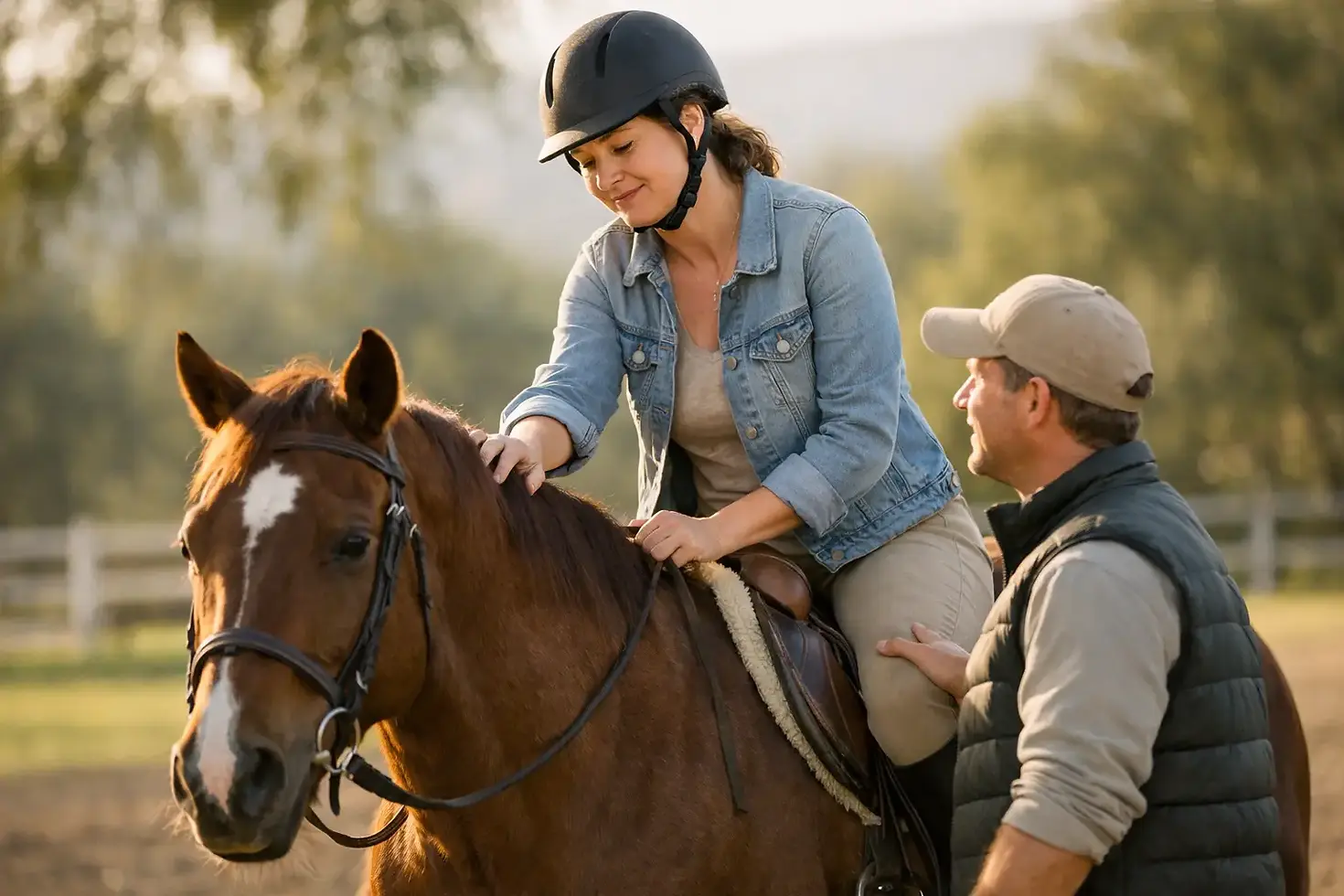
Horseback Riding for Anxious Adults
- Michelle Enos
- Jun 5
- 6 min read
Your shoulders are up by your ears before you even notice. Your mind is already scanning ahead - what could go wrong, what you forgot, what you should be doing instead. Then you step near a horse, and something shifts. Horseback riding for anxious adults can feel different from other wellness activities because it asks you to come back into your body, your breath, and the present moment in a way that is hard to fake.
For many adults who live in a constant state of pressure, horses offer a kind of honesty that feels surprisingly relieving. They do not need you to perform calm. They respond to what is real. That can sound intimidating at first, especially if anxiety already makes you feel exposed. But in the right setting, it can also be deeply grounding.
Why horseback riding for anxious adults can feel so regulating
Anxiety often pulls a person into the future. Your thoughts speed up. Your body tightens. Even rest can start to feel restless. Horses tend to bring attention back to what is happening right now. Their size, movement, warmth, and sensitivity naturally invite focus.
When you are around a horse, small things matter. The pace of your breath matters. Whether your body is braced or soft matters. Whether you are rushing or settling matters. This is part of why horseback riding for anxious adults can support nervous system regulation. The experience is sensory, relational, and embodied. You are not just talking about stress. You are noticing it in real time and, little by little, learning what helps it soften.
There is also rhythm. The repetitive motion of riding can be calming for some people, almost like the body gets a steady pattern to follow. For others, the most healing part happens before anyone gets in the saddle at all - standing beside a horse, grooming slowly, noticing the sound of hooves on dirt, feeling your breathing change without forcing it.
That distinction matters. Not every anxious adult needs intense riding instruction. Sometimes the nervous system needs safety before challenge.
The part most people worry about
A lot of adults are drawn to horses and scared of them at the same time. That does not mean horseback riding is a bad fit. It usually means your body is doing what bodies do when something feels unfamiliar, vulnerable, or big.
If you are already carrying anxiety, you may wonder whether being near a horse will make it worse. Sometimes, at first, yes - especially if you are in a loud, rushed, performance-focused environment. If the expectation is to push through fear, learn quickly, or look confident, anxiety can spike rather than settle.
But a trauma-informed approach feels different. You are not expected to override your instincts or disconnect from yourself to get through the experience. You are invited to notice what is happening inside you, go slowly, and build trust over time. That might mean starting on the ground. It might mean riding later, not right away. It might mean learning that feeling anxious does not mean you are failing.
For many adults, that is the healing. Not just being on a horse, but having an experience where your nervous system is respected instead of rushed.
What helps horseback riding feel safer
The setting matters as much as the horse. A calm environment, a grounded guide, and a horse chosen carefully for temperament can make a tremendous difference. So can clear communication. Adults with anxiety often do better when they know what to expect, what their choices are, and that they are allowed to pause.
A gentle first experience usually includes a slower pace, simple instructions, and permission to stay connected to your body instead of trying to impress anyone. Some people feel safer with basic grooming and leading before riding. Others want the structure of getting in the saddle because it gives their mind one clear thing to focus on.
It depends on the person. Someone with generalized anxiety may benefit from rhythm and repetition. Someone with trauma history may need more emphasis on choice, pacing, and relational safety. Someone who is burned out or chronically overstimulated may find the ranch environment itself is part of the medicine - open space, less noise, fewer demands, a little room to exhale.
Horseback riding for anxious adults is not about doing it perfectly
Adults who are used to functioning at a high level often bring that same pressure into healing spaces. They want to get it right. They want to be the easy client, the quick learner, the person who is not too much trouble. Horses tend to interrupt that pattern.
You cannot white-knuckle your way into connection with a horse. You cannot multitask your way into presence. If your body is tense, the horse may notice. If your attention is fragmented, the horse may respond to that too. Not to punish you, but because horses are perceptive and relational.
Strangely, this can be a relief. It gives anxious adults a chance to practice something many of them rarely experience - being with what is true without needing to hide it. You might notice fear. You might notice self-doubt. You might notice a wave of emotion you did not expect. And if the space is emotionally safe, those moments do not have to be embarrassing. They can become openings.
This is one reason equine-assisted work can feel so different from a standard lesson. The goal is not just skill. The goal is awareness, regulation, confidence, and connection that grows from real experience.
What riding can build over time
Confidence with horses tends to grow in quiet ways. Not always with a dramatic breakthrough, but with small moments that add up. The first time you notice your breathing slow on its own. The first time you set a boundary and realize it was respected. The first time your body feels strong instead of braced.
For anxious adults, these moments matter because anxiety often shrinks life. It can make your world feel smaller, your choices narrower, your body less trustworthy. Riding, when approached with care, can gently widen that world again.
You may begin to feel more steady making decisions. More aware of your body before it reaches full overwhelm. More able to recover after stress instead of staying activated for hours. Some people also rediscover play, joy, or a sense of aliveness that has been buried under responsibility for a long time.
That does not mean horseback riding is a cure-all. If anxiety is severe, untreated, or tied to panic, trauma, or dissociation, riding may need to be part of a broader support system rather than the whole answer. There are also practical realities. Horses are large animals. Riding involves risk. The right fit depends on health history, comfort level, and the quality of the environment.
Still, for many people, the combination of relationship, movement, and nature reaches something that words alone do not.
When equine therapy may be a better fit than lessons
Some adults search for horseback riding because they want calm, but what they are really longing for is support. If anxiety shows up alongside burnout, grief, trauma, emotional dysregulation, or a constant sense of being stuck in survival mode, therapeutic horse experiences may be more supportive than traditional riding lessons.
In a therapy-centered setting, the focus is less on performance and more on what happens inside you as you interact with the horse. A moment of hesitation becomes meaningful. So does your impulse to apologize, shut down, overdo, or disconnect. The horse can help reflect patterns, and a trained therapist can help you work with them gently.
That kind of space can be especially helpful for adults who are tired of trying to think their way out of anxiety. At Deerhorn Ranch in Felton, this is part of what makes the work feel different. The horses are not there to judge how polished you look. They help create room for slowing down, listening inward, and rebuilding a sense of safety in your body and relationships.
If you are curious but nervous
You do not need to be fearless to begin. You do not need prior horse experience, a certain personality, or a perfectly regulated nervous system. You just need a setting that honors your pace and an openness to meeting yourself a little more honestly.
A good first step is asking questions. Will you be expected to ride right away? How is safety handled? Is the environment trauma-informed? Are you allowed to go slowly? These are not small details. For anxious adults, they can shape whether an experience feels empowering or overwhelming.
Sometimes healing starts with something very simple: standing in a quiet place, next to a living being that is not asking you to explain yourself. Just asking you to be here now, one breath at a time.
And for people who have spent a long time carrying too much, that can be its own kind of medicine.


Comments