



Horseback Riding or Equine Therapy for Stress?
- Michelle Enos
- Aug 10
- 6 min read
A quiet horse standing nearby can make a busy mind feel a little less crowded. But when you are longing for relief from anxiety, burnout, grief, or the feeling that you have been holding everything together for too long, the choice between horseback riding or equine therapy matters. Both can be meaningful. They simply offer different kinds of support.
For some people, getting in the saddle is joyful, freeing, and confidence-building. For others, the most healing moment happens with both feet on the ground: noticing a horse’s breath, feeling their own body settle, or practicing a relationship that does not require them to perform, explain, or get everything right.
Horseback Riding or Equine Therapy: The Core Difference
Horseback riding is a recreational activity and a skill. Lessons may focus on learning how to groom, lead, tack up, steer, balance, communicate through your body, and care for a horse safely. A good instructor can help a rider build confidence over time, develop patience, and experience the satisfaction of learning something new.
Equine-assisted psychotherapy is mental health treatment facilitated by a licensed or appropriately credentialed therapist. Horses are part of an experiential therapeutic process that may include mindfulness, somatic awareness, attachment-focused work, and conversations about what is happening in the moment. The focus is not on becoming an accomplished rider. It is on what the relationship, activity, and environment reveal about your nervous system, emotions, patterns, and needs.
At Deerhorn Ranch, horses are not treated as tools for a lesson or a quick fix. They are responsive partners in a carefully held therapeutic space. Their sensitivity to movement, energy, boundaries, and connection can create opportunities to notice what is often hard to name in an office.
Neither experience is better across the board. The better fit depends on what you are seeking, what feels safe in your body, and the kind of support you need right now.
What Horseback Riding Can Offer
Riding asks you to be present. A horse is large, responsive, and very much in the moment. When you are learning to ride, it is difficult to scroll through an old argument in your head while also paying attention to your posture, your horse’s rhythm, and the instructor’s guidance. For many people, that focus alone feels like a reset.
The physical experience can also be deeply regulating. Grooming, walking alongside a horse, and moving with a horse’s steady gait can bring you out of constant mental activity and back into your senses. Riding can offer fresh air, movement, accomplishment, and a sense of connection with an animal who has no interest in your productivity or your inbox.
There is real emotional value in learning a skill, especially for someone whose confidence has taken a hit. A rider may feel pride after asking clearly for what they need, staying calm through a challenging moment, or realizing that progress does not have to be perfect to count.
Still, riding lessons are not automatically therapy. An instructor may be caring, observant, and encouraging, but they are not necessarily trained to assess trauma responses, work with emotional dysregulation, or help a client process painful material that comes to the surface. If your main goal is recreation, horsemanship, movement, or learning to ride, that may be exactly what you need. If you are seeking support for mental health concerns, it helps to choose a clinical therapeutic setting.
When riding may be a good fit
Horseback riding may be a beautiful choice when you want a hobby that gets you outdoors, a physical practice that builds confidence, or a structured way to connect with horses. It can be especially supportive for someone who feels ready for challenge and enjoys learning through action.
It is also worth remembering that not everyone feels calm around horses at first. Riding requires safety instruction, physical coordination, and a willingness to work with some uncertainty. A thoughtful program will move at a pace that respects both the rider and the horse.
What Equine Therapy Can Offer
Equine therapy begins with a different question: what is your experience telling you right now?
Maybe you arrive feeling numb after another week of caregiving. Maybe you have been productive all day but cannot settle when you get home. Maybe your teen is overwhelmed, shut down, or tired of trying to describe feelings they cannot quite put into words. In an equine-assisted psychotherapy session, those experiences do not need to be tidied up before you arrive.
A horse may move closer when you soften your body, step away when you feel tense, or pause at a boundary. These moments are not interpreted as simple answers or mystical messages. Instead, a therapist can help you become curious. What happened inside you when the horse turned away? Did you feel rejected, relieved, frustrated, invisible? Did you notice your breath change? What might it be like to slow down, regulate, and try a different approach?
This is where the work can become powerful. Rather than only talking about a pattern, you get to experience it in real time, with support. Someone who tends to over-function may notice how quickly they take over a task. Someone who struggles to ask for help may practice clearer communication. Someone who has spent years bracing for conflict may discover that calm boundaries can be firm without being harsh.
For people living with trauma, chronic stress, ADHD-related overwhelm, depression, or anxiety, this body-based awareness can matter. Stress is not only a thought problem. It can show up as a clenched jaw, shallow breathing, restlessness, disconnection, or the sense that even small tasks are too much. Therapy with horses can offer a slower, more tangible way to recognize those signals and practice coming back to safety.
You do not have to ride
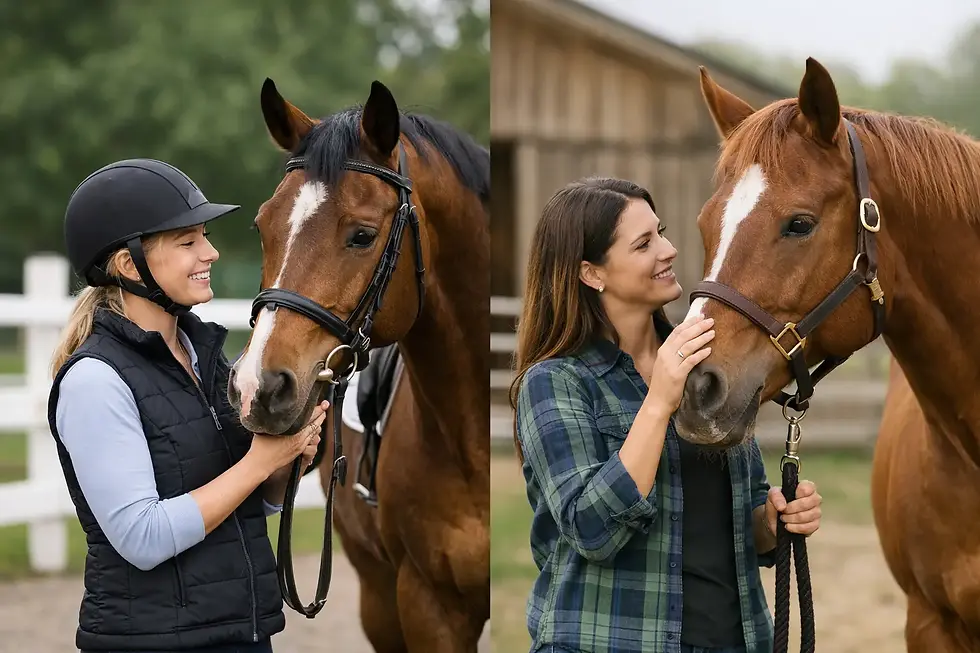
One common misconception is that equine therapy means horseback riding. Often, it does not. Many therapeutic sessions take place on the ground through observation, grooming, leading, walking, relational exercises, or simply sharing space with horses.
This is intentional. Being on the ground can make room for choice, pace, and awareness. It can also be more accessible for people who have never ridden, do not wish to ride, or feel anxious around horses. The goal is not to push through fear for the sake of a breakthrough. The goal is to build enough safety that honest connection and meaningful growth can happen.
Choosing the Support That Feels Right
If you are deciding between horseback riding and equine therapy, begin with your reason for seeking it. You do not need a perfect answer. A few honest questions can help clarify the path.
Are you hoping to learn a new skill, spend time outdoors, and enjoy a relationship with horses? Riding lessons or a horsemanship program may be a nourishing fit. Are you looking for help with panic, grief, trauma, burnout, relationship patterns, or emotions that feel hard to manage? Equine-assisted psychotherapy may offer the clinical support and emotional containment you need.
You can also want both. A person might find joy and confidence in riding while separately choosing therapy for deeper healing. Sometimes a season calls for challenge and movement. Sometimes it calls for slowing down enough to notice how tired you really are.
The setting matters, too. Ask whether the experience is led by a qualified mental health professional if you are seeking therapy. Notice whether the program respects consent, emotional safety, physical safety, and the welfare of the horses. A trauma-informed space will not pressure you to disclose more than you are ready to share or treat discomfort as something you must overcome immediately.
Healing Is Not a Performance
Many high-functioning people arrive already skilled at pushing through. They can care for everyone else, meet the deadline, smile in the meeting, and keep moving even when their body is asking for rest. A ranch setting can gently interrupt that pattern.
Horses do not need you to be impressive. They respond to presence more than polish. They invite a different kind of attention: one that is slower, more honest, and more connected to what is happening beneath the surface.
Whether you choose the joy of riding or the deeper support of equine therapy, let the experience be something you do with yourself, not another way to measure yourself. A few quiet minutes beside a horse can be a small beginning: a chance to breathe, feel your feet on the ground, and remember that you do not have to carry every hard thing alone.


Comments